

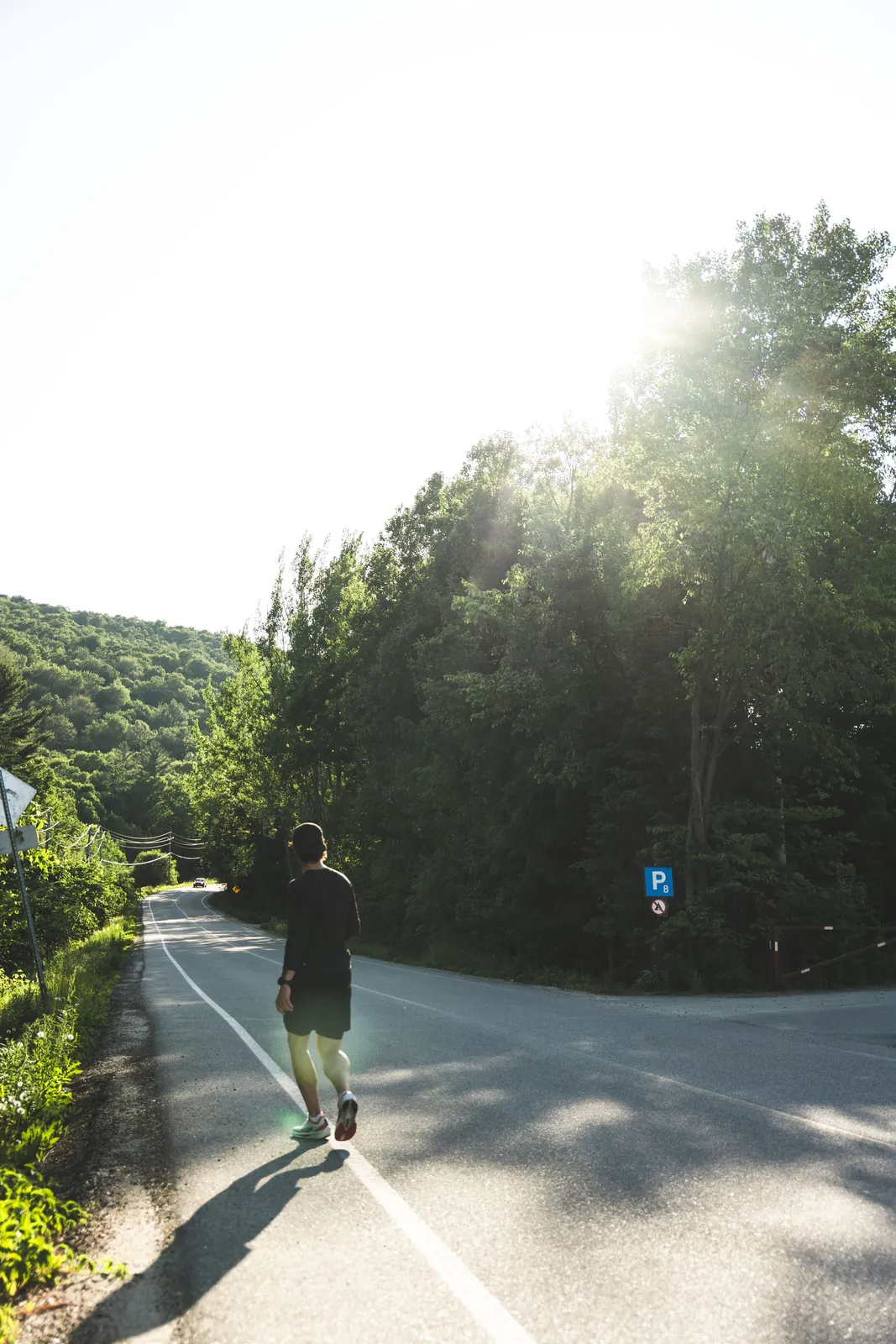
Running outside usually burns slightly more calories than running at the same speed on a treadmill. The main reasons are air resistance, hills and uneven ground. The gap is smaller than many people think, and setting the treadmill to a 1% incline closes most of it.
What the research found
The best-known study on this is Jones and Doust (1996). They found that a 1% treadmill incline most closely matched the energy cost of running on a flat road, at speeds from about 10.5 to 18 km/h (roughly 6.5 to 11 mph). The difference comes mostly from air resistance: outdoors you push through still air, and on a treadmill you don’t. Air resistance rises steeply with speed, so at easy jogging and walking speeds the gap is small.
Source: Jones & Doust, Journal of Sports Sciences, 1996.
What else makes outdoor running different
- Wind: a headwind adds effort; a tailwind gives some back.
- Hills: uphill costs more energy than downhill gives back.
- Surface: grass, sand and trails take more effort than smooth road.
- Pace changes: traffic lights, corners and crowds.
- Weather: heat and humidity raise the effort at a given pace.
What makes the treadmill easier (and harder)
- Easier: no air resistance, the belt helps your leg move back a little, perfectly flat surface.
- Harder: no breeze to cool you, so you can overheat. A fan helps. Mentally, holding a set pace can feel tougher.
Calories: what to trust
The calories you burn depend mostly on your body weight, speed, incline and time. Treadmill consoles estimate this, often generously if you hold the rails. For a range based on standard equations, use the calorie estimator. The incline calories guide shows the formula.
Which should you choose?
| If you want to… | Better choice |
|---|---|
| Race outdoors | Mostly outdoors, with treadmill sessions for control |
| Control pace or incline precisely | Treadmill |
| Run safely in dark, ice or heat | Treadmill |
| Enjoy variety and scenery | Outdoors |
| Burn slightly more at the same speed | Outdoors, or treadmill at 1% |
