

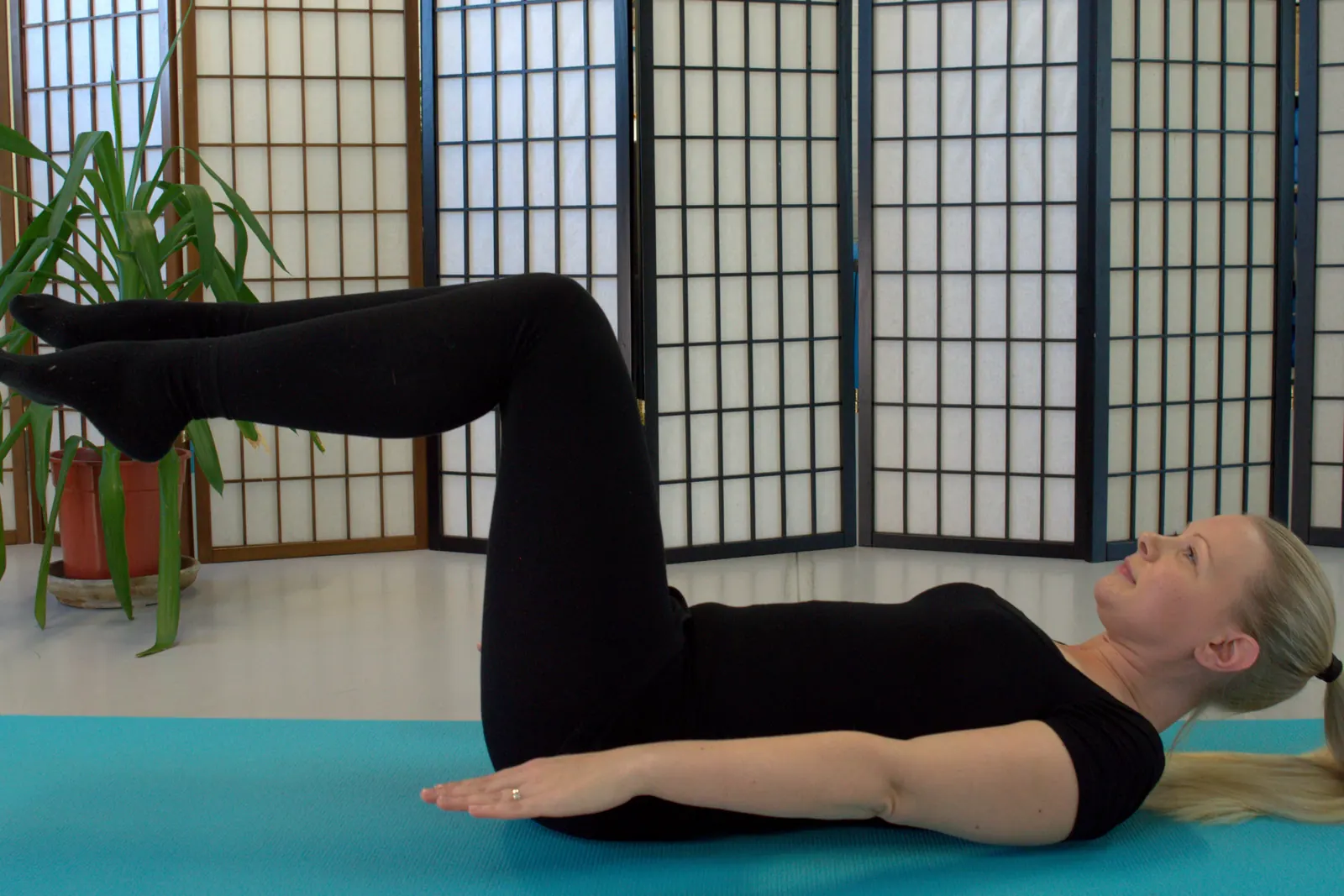
Photo: Helisusa, Wikimedia Commons, CC BY-SA 4.0
The Hundred is one of the best-known Pilates moves: you hold a curled-up position and pump your arms for 100 counts while breathing in a steady rhythm. It’s a warm-up in classical Pilates, but it’s harder than it looks. Here’s how to set it up, the common mistakes, and easier versions to build from.
How to do the Hundred
- Start on your back with your knees bent and feet on the mat, arms by your sides.
- Bring your legs to tabletop: knees over hips, shins parallel to the floor.
- Curl up. Breathe out and lift your head and shoulders, looking toward your knees. Reach your arms long, a few centimetres above the mat.
- Pump the arms. Make small, brisk up-and-down movements from the shoulders, keeping the arms straight.
- Breathe in a rhythm. Breathe in for five pumps, out for five pumps. Ten full breaths makes 100.
- Finish with control. Bring your knees toward your chest and lower your head down.
The advanced version straightens the legs to around 45 degrees or lower. Only lower the legs as far as you can without your lower back arching off the mat.
Common mistakes
- Neck strain. Usually from pulling the chin to the chest or curling too high. Keep a gap the size of a small fist between your chin and chest, and lower your head if it aches.
- Arching the lower back. A sign your legs are too low or too straight for your strength. Bend your knees or raise your legs.
- Big, floppy arm swings. Keep the pumps small and controlled, from the shoulders.
- Holding your breath. Count out loud quietly if it helps.
- Shoulders up by the ears. Reach your fingertips toward your feet to draw the shoulders down.
Easier versions
| Level | Head | Legs |
|---|---|---|
| 1 | Down, resting on the mat | Feet on the mat, knees bent |
| 2 | Down | Tabletop |
| 3 | Curled up | Feet on the mat |
| 4 | Curled up | Tabletop |
| 5 | Curled up | Legs straight, angled up |
You can also split the 100 counts into sets: 50, rest, 50. That’s a good way to keep form clean while you build up.
Who should skip or modify it
People with neck problems, osteoporosis, recent abdominal surgery, or who are pregnant or recently postpartum are often advised to avoid or adapt repeated curling moves. If that’s you, ask an instructor or physiotherapist for an alternative such as head-down versions.
